Turn your backyard into a bird feeding sanctuary and discover tranquility in your backyard.

Tuesday, October 21, 2014

Get Ready for the Redpolls

With winter approaching, we are starting to see birds migrating to their winter feeding grounds.  That means that the redpolls hopefully will be showing up at my feeders later this fall.

Did you know that Common Redpolls and Hoary Redpolls are generally found year round up north in the North West Territories, Nunavut, the Yukon and Alaska? They actually breed in the very northern edges of these areas right around the Arctic Ocean. According to the the Cornell Lab of Ornithology, these hardy little souls can survive temperatures of -65 degrees F (-53 degrees C)!

In the winter months, though, even these birds say "enough is enough" and many will migrate further south and be found down in southern parts of Canada and even down into the central or southern States. They are considered "irruptive" meaning that they follow food sources and their migration can not be predicted year to year.  So some years there will be many in an area and some years not.  Like Pine Siskins, these birds travel in flocks and when crowded at a feeder, can be susceptible to salmonella infections.


So how do you recognize a redpoll in your backyard?  Well it is a small bird and different from a house finch or purple finch in that it has a distinctive red cap on it's head.  The Hoary Redpolls are lighter coloured than the Common Redpolls, but the Common are more common so, given my lack of skills in identifying birds, I presume the ones in my backyard are Common Redpolls.

We thoroughly enjoy watching the redpolls at our feeders as they quarrel among each other and
have unique personalities.  We find that redpolls will eat from many different styles of feeders but seem to prefer our Mother Nature's Finch mix in a tube feeder or medium sunflower chips in a hopper style feeder.

Please remember to be extra careful about keeping your feeders clean of any bird droppings if you have large flocks of redpolls in your yard, given their susceptibility to salmonella.

A couple of final neat facts about redpolls again from the Cornell Lab of Ornithology:
1) they tunnel into the snow at night to keep warm
2) they can travel very long distances and have been recorded to travel as far as from China to Belgium.
 
What interesting lives these birds must lead!  Keep your feeders stocked for redpolls this winter.


Monday, February 10, 2014

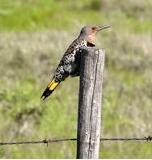
Northern Flickers are one of my favorite birds and I have a few of them frequenting my feeders at this time of year.  Flickers are not as common as some of the other birds in your backyard, so I thought I would give you a bit of information on Northern Flickers and how to attract them.

Northern Flickers are part of the woodpecker family and spend most of their time on tree trunks or on the ground foraging for ants or other insects.   However, they do seem to enjoy the sunflower seeds and peanuts in our Jay & Woodpecker mix and I quite enjoy seeing one of these large flickers plop down in my platform feeder. These easy going birds are big enough that when they arrive at the feeder, even the blue jays and magpies think twice about trying to scare them off.

There are two forms of these flickers: yellow-shafted and red-shafted and they can interbreed when ranges overlap. The Yellow-shafted Flicker resides in north and eastern North America. As the name suggests, the yellow-shafted flickers have yellow under the tail and wings. They also have a grey cap, a beige face and a red bar at the nape of their neck. Males have a black mustache.

The Red-shafted Flicker resides in western North America. Very similar to the Yellow-Shafted flicker but with red under the tail and wings.  

These birds are migratory and I believe we have had both red and yellow shafted flickers in our yard over the winter at different times.

To attract these birds to your yard, I recommend offering Mother Nature's Jay & Woodpecker Mix in a tray feeder or platform feeder positioned near some trees in your yard.  I also recommend having several suet feeders positioned around your yard as they enjoy suet very much in the winter time.

Monday, October 21, 2013

The benefits of a fly-through feeder.

I was so excited yesterday.  I have been looking for a really large good quality wooden feeder for a while now.  However, most of the stores I have been in i.e. Canadian Tire just have small feeders.  So yesterday I was visiting one of our customers and there on the shelf was the feeder I have been looking for! 

This feeder by Wild Bird Trading Company is what I call a "fly - through feeder" meaning that it is ideal for birds that just want to fly in, grab a seed and fly out quickly.  This particular one is very large making it suitable for blue jays and large woodpeckers like northern flickers.

Some people complain about the jays in the yard chasing off other birds but I love jays and while I have seen them pass through my yard they have rarely stuck around.  So when I hung this feeder up yesterday I was hopeful but didn't know what to expect.  Well within a couple of hours I had 3 blue jays coming and going.  It was like grand central station and the other birds could still eat at the other feeders without worrying about the jays.

This feeder was about $60 at Green Haven Garden Centre in Lethbridge and based on my experience with feeders I think it is very good quality and a good price for what you are getting.  So consider putting up a feeder just for the blue jays. They can provide hours of entertainment in the backyard and that flash of blue is beautiful especially against the snow in winter time.

Tuesday, June 25, 2013

No Mess Solutions for Backyard Bird Feeding

Love the birds but don’t love the mess that goes with them? Many backyard bird feeders stop feeding birds over the summer, choosing to focus instead on the perfect lawn and garden.  However, there is a way to have your perfect lawn and your backyard birds too, if you make the correct bird food choices.

It all starts with selecting the right bird food. It is important to select seeds and nuts that have no shells and that won’t sprout under your feeder. I give a "no mess" rating to ingredients like chopped sunflower kernels (also known as sunflower chips) and chopped nuts. Birds love sunflower seeds and when you remove the shells and chop up the seeds, you eliminate mess and sprouting under the feeder.
 
Skinless peanuts and chopped nuts are also bird favorites and have a low mess factor when fed through a peanut feeder. The chickadees, nuthatches and woodpeckers all really enjoy nuts.
 
Just a plug here for our Mother Nature's No Mess Gardener's blend (available at UFA, Buckerfields and other retailers):  This blend contains chopped sunflower kernels, peanuts and tree nuts.  The birds love these ingredients so there should be very little waste associated with this mix.  It also has no shells to make a mess under the feeder and no seeds that will germinate in your lawn.  

Finally, as an alternative or an addition to the above, you may want to consider feeding a "no melt" suet in the summer time. Suet is a beef kidney fat bird product and no melt suets are guaranteed not to melt when summer temperatures soar. Suet is popular with many birds and there are no shells or seeds that will fall to the ground from a suet feeder.

Birds can be messy it seems, choosing at times to toss the seed out of the feeder only to eat it on the ground later. You can avoid these issues by adding a seed catching tray under your feeder.

There is something peaceful about sitting in the garden and watching the birds at the feeder. Bird feeding brings tranquility to my backyard and makes backyard gardening that much more enjoyable.


Monday, June 3, 2013

Goldfinches don’t hit the dog’s radar.


We have a watchdog you know. She valiantly protects our yard from interlopers including cats and large birds such as grackles and crows (and unfortunately large woodpeckers, doves or jays).
It’s funny though that she seems to have a risk assessment based on the size of the interloper and apparently gold finches don’t cross the risk line. She is happy to let the finches munch away at the feeders.

I am very pleased to have the goldfinches back in my yard. These cheery little guys will eat at the feeder even while I’m sipping coffee on the deck and the dog on watch. I find that they add such nice flashes of color against the spring greenery of the yard.
 
As an aside, I am feeding the goldfinches finely chopped sunflower chips (kernels) – I also have a another feeder elsewhere in the yard where I alternate nyjer seed and our Mother Nature’s finch mix as well.   To find our Mother Nature's bird seed please see our website:  http://www.chinridge.com/index.php/where-to-buy-our-pet-and-wild-animal-food-products


Friday, May 17, 2013

Attracting Nuthatches to your Backyard

Nuthatches are one of my favorite backyard birds.  So small and yet fiesty, I enjoy seeing these colourful Red Breasted Nuthatches coming to and from my feeders.  It is easy to see which seeds they enjoy the most based on the feeders that they frequent.
In my backyard, the nut feeder is a favorite for the nuthatches.They enjoy the tree nuts (a mix of cashew, hazelnut, almonds and other nuts) and are often seen at that feeder.

Secondly, they really enjoy the finch feeder with the fine sunflower chips (sunflower seeds with the shell removed - chopped finely into little pieces).

They also seem to enjoy eating insects from an old decrepit tree trunk in my backyard and will visit my suet feeders.  I will also see them taking black oil sunflower (shell on) or a peanut from another mix in my hopper feeder.

Nuthatches are busy birds and are not likely to stay long at the feeder.  They zoom in, grab a seed and zoom out, off to wherever they are headed.

If you are having trouble attracting nuthatches, try to offer some of the bird foods I mentioned above.  Note though that you will have a greater chance of attracting them if you have some coniferous treas around your yard.  Red Breasted Nuthatches are considered a short distance migrant and may not migrate at all if you are in the southern part of the Canadian provinces.  So keep those feeders full because once you attract these cute little guys, you could have them there to stay.


Wednesday, March 20, 2013

Variations on Suet Bird Feeders

I think we are all pretty familiar with the standard suet cage feeder.  However, recently, one of our customers showed us an innovative modification to one of these feeders.

He attached a piece of wood to the bottom of this feeder and explained how this allows birds to have somewhere to rest their tail when they feed, which gives them better balance and allows them to feed more comfortably.   This explains the long tail on some of those suet feeders that you can purchase in stores, or if you already have a suet feeder, you can make it yourself by simply adding a piece of wood onto the bottom similar to the one shown in this photo. 
 
Another interesting suet feeder to consider is a bottom feeding suet feeder, which is entirely covered on the top and sides, and has a mesh underside.  This forces the bird to get to the suet by hanging underneath the feeder. This unique feeder will allow only birds that are comfortable clinging upside down to get to the suet (birds like woodpeckers, nuthatches, chickadees). If these are the types of birds you wish to attract to your yard, this is a great feeder to use.