Turn your backyard into a bird feeding sanctuary and discover tranquility in your backyard.

Thursday, July 16, 2015

How to keep bird seed fresh.

We often get asked if it is possible to keep birdseed fresh for a longer period of time. While we typically suggest a bird seed shelf life of about 6 months, there are a few things that you can do in order to keep your birdseed fresh longer.
  • Buy fresh seed in good condition:  The first thing to ensure is that the seed you are buying is fresh from the start. Make sure that you have a good look at the bag you are considering buying.  If the seed appears dusty or discolored, or has any sort of cobwebs, do not buy it. Avoid any bag that appears worn out or dusty, as it is possible that it has been sitting on the shelf too long already.  Also check to see if there is a manufacturing date or code on the bag so you know for sure when the birdseed was made.  
  • Store your seed in an airtight container:  After you have purchased your birdseed, it is important to consider the type of container that your seed will be stored in.  If your seed is in a bag it is best to change it to another type of container as most bags have small holes in it to allow bags to stack better when shipping.  However these small holes could allow insects or moisture to get inside the bag.  A great alternative is to transfer your seed into an airtight plastic or metal container.   
  • Store your seed in a cool dry spot:  Once you have your seed in an airtight container, you will need to determine where you are going to place the seed.  Temperature plays a major role in how long your birdseed will stay fresh.  If the seed is stored at a temperature that is too warm, it will spoil a lot faster. Most homes are too warm to store seed. Therefore, a cool garage or garden shed are great options.  During the summer months, it is a good idea to move your seed to a freezer if possible.  Keeping the seed frozen will not affect the seed quality and will help to prevent the seed from spoiling. 

It is always a good idea to do occasional quality checks on your seed.  Ensure that there are no signs of insects, or insect cobwebs.  The seed should not be discolored in any way, and you should check to make sure the smell is not ‘off’ and remains fresh.

If you follow these tips, you should be able to ensure your seed stays fresh for your feathered friends.

Wednesday, June 17, 2015

Summer Bird Feeding Tips

It’s that time of year again!

The weather is beautiful, and it’s the perfect time to sit outside and enjoy watching all the birds visiting your backyard.  Don’t forget to keep your feeders filled during the summer months.

You may assume that birds have a lot of food to eat in the wild at this time of year, and while this may be true, they can still benefit from our help.  Many birds are breeding and nesting during the summer, and by keeping our feeders filled, it allows these birds to stay close to their young ones.

Here are a few summertime tips to keep the backyard birds happy and healthy throughout the season:


  1. Add water to your backyard:  Birds really love water, and even though water is more accessible during the summer months, bird baths are great to have in your backyard.  Having a bird bath will attract more birds into your yard.  Just be sure to keep bird bath clean, empty the old water and refresh it on a daily basis.  This will help to make sure that your bird bath will not become breeding grounds for pesky mosquitoes. 
  2. Set up a sugar water feeder:  If you would like to attract a wider range of birds, such as hummingbirds, orioles, sapsuckers, purple finches, tanagers, and warblers, you can set up a sugar water solution feeder. Just make sure that the water gets changed every couple of days when it is hot outside to prevent it from getting mouldy. 
  3. Protect bird health by keeping feeders clean:  It is also very important to ensure that you are keeping your feeder clean at all times during the year, but especially during the summer months. Summer temperatures bring with it an ideal time for bacterial growth in your feeder. You can keep your feeders clean by following these simple steps:  


  • Scrub your feeder with hot soapy water about once per month & allow them to air-dry afterwards.
  • Wipe down perches and feeding portals on the feeder with a cloth dipped in a weak bleach solution,.  This will prevent the spread of salmonella. 
  • Fill your feeders with small amounts of seed more frequently rather than large amounts all at once.  This will keep the food from spoiling which could pose a health risk to the birds. 
  • In an open tray feeder, remove any food soaked by rain, as well as any bird droppings.  This will also help prevent the spread of diseases. 

If you follow these simple tips, your backyards birds will be happy and healthy, and you will surely enjoy seeing various birds visiting your backyard throughout the summer season.

Tuesday, April 28, 2015

How to attract finches to your yard this spring.


Spring and summer are great times of the year for feeding finches. Goldfinches become a beautiful yellow in these months and house finches, purple finches and pine siskins are plentiful. So how do you attract these little birds to your feeders?

goldfinch
Start with the right feeder: Purchase a tube thistle finch feeder. This will be a long cylindrical feeder with small perches and very small seed holes.

Put the feeder in the right location: Mount the feeder in a tree or bush where you have seen finches before. You can move the feeder closer to the house once your birds are used to the feeder and regularly visiting it.

Choose the right food: Goldfinches are known for their love of njyer seed (pictured left).

However,there are other options. The variety of ingredients in Mother Nature's Finch Mix is designed to attract redpolls, pine siskins, goldfinches, housefinches and other finches. Our Mother Nature's finch mix contains ingredients that these small birds love including nyjer seed, finely chopped sunflower seed, canola seed, canarygrass seed, and gold proso millet.

Another option to consider, particularly if you are looking for a "no mess" solution, is our Mother Nature's Fine Chips which are finely chopped sunflower kernels. They feed well through the small holes in finch feeders and are very popular with finches. While the fine chips are a bit more expensive than our Mother Nature's finch mix, there will be no shells under the feeder and no sprouting to worry about.

Finally, when you have your feeder up, you could consider adding a birdbath to your yard. All birds including finches enjoy water.

Thursday, February 26, 2015

The Ultimate Bird Food: Black Oil Sunflower Seed

There are so many different kinds of seeds in bird seed mixes and it can be kind of confusing to know what mix to buy and use in your feeders.  Well today I wanted to shine some light on the ultimate bird food, black oil sunflower, and explain why you should buy mixes that contain a high percentage of this nutritious seed.

Black oil sunflower is a much loved food source for wild birds.  In fact, studies have shown that black oil sunflower is the top choice of most seed eating birds from chickadees to sparrows.  So why is black oil sunflower so popular?  

Sunflower plants in bloom.  The center of the flower contains
the seed which will turn black when the plant is mature.
Well black oil sunflower has a very high oil content, as high as 40%. This oil content acts as a very important energy source for wild birds who have to stay warm in the winter, migrate in the spring and fall and raise young during the summer. There are other bird foods with high oil contents as well, like peanuts and safflower, but the birds appear to be more attracted to sunflower than these other food sources.  

Sunflowers can be offered on their own or with other seeds in a mix but you will find that mixes with higher sunflower content will be more popular and attract a broader variety of birds than mixes with low sunflower content.

Whole sunflower kernels
The great thing about sunflower though, is that in addition to feeding the sunflower seed whole in-shell, you can also feed sunflower kernels. Sunflower kernels are sunflower seeds that have had their shells removed by a dehuller.  These kernels are sized to be either whole kernels or broken kernels in medium or small size pieces.  We call these hulled sunflower kernels "sunflower chips" and one of our most popular products is our Mother Nature's Medium Sunflower Chips. Sunflower chips provide a "super accessible" high energy food source for birds.  In addition, they are a "no mess" solution because there are no shells to clean up under the feeder and the broken kernels will not sprout. 

If you buy the fine size sunflower kernels - Fine Sunflower Chips, you can use these chips in place of, or combined with, Nyjer seed in a finch tube feeder.  The small sized chips will work just fine with the small size holes you will find in finch feeders.  In fact, my experience is that the finches love the fine sunflower chips as much or more than Nyjer seed.  

So hopefully, I have demystified black oil sunflowers a bit for you and you will understand why they are an important food for backyard bird feeding.

Monday, November 10, 2014

Winter bird feeding tips.

Brrrrr...... it's suddenly so cold out there! So glad I filled the bird feeders yesterday while it was still beautifully snowy but not frigidly cold.

With the arrival of the cold weather I thought that now might be a good time for a few quick tips on how to feed the birds to help them survive a cold winter.

Winter bird feeding tips:

1) Stock those feeders!  Birds need lots of calories to keep warm on cold winter days.  Provide food that has the maximum bang for the calorie buck:

  • Black oil sunflower chips (sometimes called sunflower kernels or hearts) have a high fat content that can help power little birds on those cold winter days.  The fact that the sunflower shell has been removed means that the food takes less effort to consume which can also help.
  • Skinless peanuts have a high calorie and fat content which is important for birds in the winter time.  
  • Suet (beef kidney fat that has been specially prepared) is another great energy source for birds on cold winter days.

2) Regularly fill your feeders!  Now that the birds have found your backyard and are relying on your help to survive the cold, it's important to keep the food coming.

3) Put up a few different types of feeders in your yard.  This will spread the birds out and reduce competition at your feeders.

4)  Keep the feeders clean of snow.  Snow on the feeder just blocks the seed holes and leads to seed spoilage if and when the snow melts, so try to keep your feeders brushed off.

5) Keep your feeders clean of mess.  Some birds are very susceptible to salmonella.  Bird droppings on the feeder and around the feeder can help spread this sickness from one bird to another especially when you have lots of birds at your feeders.

Those are a few tips for the day.  Happy winter bird feeding!

Kelly


Tuesday, October 21, 2014

Get Ready for the Redpolls

With winter approaching, we are starting to see birds migrating to their winter feeding grounds.  That means that the redpolls hopefully will be showing up at my feeders later this fall.

Did you know that Common Redpolls and Hoary Redpolls are generally found year round up north in the North West Territories, Nunavut, the Yukon and Alaska? They actually breed in the very northern edges of these areas right around the Arctic Ocean. According to the the Cornell Lab of Ornithology, these hardy little souls can survive temperatures of -65 degrees F (-53 degrees C)!

In the winter months, though, even these birds say "enough is enough" and many will migrate further south and be found down in southern parts of Canada and even down into the central or southern States. They are considered "irruptive" meaning that they follow food sources and their migration can not be predicted year to year.  So some years there will be many in an area and some years not.  Like Pine Siskins, these birds travel in flocks and when crowded at a feeder, can be susceptible to salmonella infections.


So how do you recognize a redpoll in your backyard?  Well it is a small bird and different from a house finch or purple finch in that it has a distinctive red cap on it's head.  The Hoary Redpolls are lighter coloured than the Common Redpolls, but the Common are more common so, given my lack of skills in identifying birds, I presume the ones in my backyard are Common Redpolls.

We thoroughly enjoy watching the redpolls at our feeders as they quarrel among each other and
have unique personalities.  We find that redpolls will eat from many different styles of feeders but seem to prefer our Mother Nature's Finch mix in a tube feeder or medium sunflower chips in a hopper style feeder.

Please remember to be extra careful about keeping your feeders clean of any bird droppings if you have large flocks of redpolls in your yard, given their susceptibility to salmonella.

A couple of final neat facts about redpolls again from the Cornell Lab of Ornithology:
1) they tunnel into the snow at night to keep warm
2) they can travel very long distances and have been recorded to travel as far as from China to Belgium.
 
What interesting lives these birds must lead!  Keep your feeders stocked for redpolls this winter.


Monday, February 10, 2014

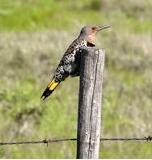
Northern Flickers are one of my favorite birds and I have a few of them frequenting my feeders at this time of year.  Flickers are not as common as some of the other birds in your backyard, so I thought I would give you a bit of information on Northern Flickers and how to attract them.

Northern Flickers are part of the woodpecker family and spend most of their time on tree trunks or on the ground foraging for ants or other insects.   However, they do seem to enjoy the sunflower seeds and peanuts in our Jay & Woodpecker mix and I quite enjoy seeing one of these large flickers plop down in my platform feeder. These easy going birds are big enough that when they arrive at the feeder, even the blue jays and magpies think twice about trying to scare them off.

There are two forms of these flickers: yellow-shafted and red-shafted and they can interbreed when ranges overlap. The Yellow-shafted Flicker resides in north and eastern North America. As the name suggests, the yellow-shafted flickers have yellow under the tail and wings. They also have a grey cap, a beige face and a red bar at the nape of their neck. Males have a black mustache.

The Red-shafted Flicker resides in western North America. Very similar to the Yellow-Shafted flicker but with red under the tail and wings.  

These birds are migratory and I believe we have had both red and yellow shafted flickers in our yard over the winter at different times.

To attract these birds to your yard, I recommend offering Mother Nature's Jay & Woodpecker Mix in a tray feeder or platform feeder positioned near some trees in your yard.  I also recommend having several suet feeders positioned around your yard as they enjoy suet very much in the winter time.